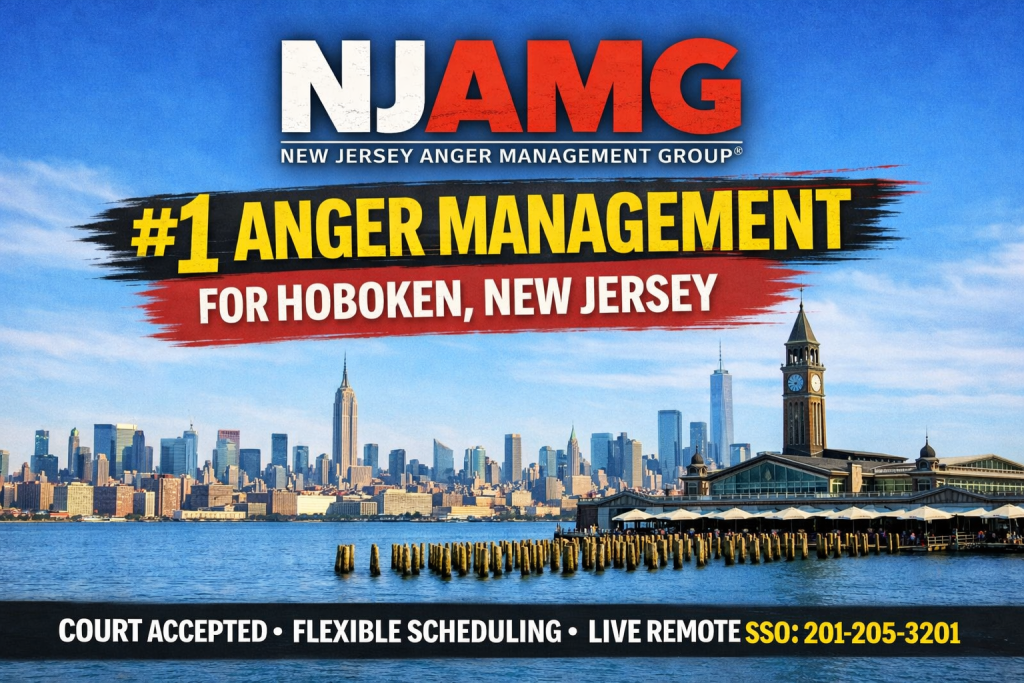
From the Brownstones of Uptown to the PATH Station Downtown, From Washington Street to the Waterfront — Why Hoboken’s 60,000 Young Professionals Choose NJAMG for Court-Approved Anger Management
In the square mile facing Manhattan — where Frank Sinatra was born, where Stevens Institute overlooks the Hudson, where PATH trains carry 20,000 daily commuters, where Washington Street pulses with bars and restaurants, where historic brownstones cost millions — New Jersey Anger Management Group serves Hoboken’s densest-in-America urban community with genuine care, powerful documentation, and real results.
🏙️ Hoboken: America’s 4th Most Densely Populated City

The numbers are staggering: 48,300 people per square mile packed into just 1.3 square miles between the Hudson River and the Palisades. That makes Hoboken the 4th most densely populated municipality in America among cities over 50,000 — denser than San Francisco, denser than Boston, surpassed only by a handful of New York City neighborhoods.
When we work with someone from Hoboken, we’re not addressing anger management in some generic suburban context. We’re addressing it in the context of living in one of America’s most compressed urban environments — where 60,000 residents share 1.3 square miles, where you hear your neighbors through brownstone walls, where parking is warfare, where personal space doesn’t exist, where the PATH train at Hoboken Terminal moves 20,000 commuters daily, where Washington Street weekend crowds feel like Times Square.
This is a city that went from industrial decline to explosive gentrification in 30 years — from 38,577 residents in 2000 to 60,419 in 2020 (a 57% increase). A city where the median household income is $176,943 — nearly double the New Jersey median — creating wealth concentration alongside economic pressure for service workers. A city where 66% of residents rent, where the median age is 31, where 81% have bachelor’s degrees, where young Wall Street professionals live next to longtime Italian families who remember when Hoboken was working-class.
📍 Hoboken’s Geography: Uptown, Midtown, Downtown in One Square Mile
Despite being tiny — you can walk the entire city in 30 minutes — Hoboken has distinct neighborhoods with different characters, demographics, and daily realities:
📍 Uptown (North of 6th Street)
Historic brownstones, quieter residential streets, family-oriented, Stevens Institute campus. More established residents, higher prices, neighborhood feel despite density.
📍 Midtown (Between 6th & 2nd Streets)
Mix of residential and commercial. Washington Street restaurant/bar corridor. Young professionals, renters, nightlife energy. Parking battles intensify here.
📍 Downtown (South of 2nd Street)
Hoboken Terminal, PATH station, ferry terminal. Highest density, newest construction, commuter stress epicenter. 20,000+ daily PATH riders surge through morning/evening.
🚊 PATH Train & Hoboken Terminal
Major transportation hub connecting NJ to Manhattan. Morning/evening crush creates daily stress. PATH delays = thousands stranded. Commuter rage trigger.
🍻 Washington Street Corridor
Restaurant row, bar scene, weekend crowds. “Hoboken’s Fifth Avenue.” Nightlife conflicts, noise complaints, public intoxication, weekend chaos from NYC visitors.
🏫 Stevens Institute of Technology
Private research university on Castle Point overlooking Hudson. Student population adds density. Tech/engineering culture. Waterfront views, institutional presence.
⚖️ We Know the Hudson County Court System Inside and Out
Hoboken feeds into Hoboken Municipal Court at 100 Newark Street and Hudson County Superior Court in Jersey City. We know these courts because New Jersey Anger Management Group was founded by a Rutgers Law School graduate with over 15 years of direct experience in New Jersey courts — including Hudson County.
Legal Expertise That Matters in Hoboken Courts
Our court documentation is written by professionals with legal backgrounds who understand what Hudson County judges, prosecutors, and probation officers need to see. When your defense attorney presents our progress report to Hoboken Municipal Court or Hudson County Superior Court, it speaks the court’s language. When your attorney includes our documentation in a PTI application to the Hudson County Prosecutor’s Office, it addresses the specific factors prosecutors weigh in Hoboken cases. This dual expertise is why Hudson County attorneys refer clients to us consistently.
Courts Serving Hoboken That Accept NJAMG Documentation
🏛️ Hoboken Municipal Court
100 Newark Street, Hoboken, NJ 07030
Phone: (201) 420-2000 ext. 1130 (Violations Bureau)
General: (201) 420-2120 | Email: hmc@hobokennj.gov
Hours: Monday–Friday, 8:00 AM – 4:00 PM
Judges: Hon. Benjamin B. Choi (Chief Judge, JMC), Hon. Scott Pennington (JMC)
Court Administrator: Kerri Azzoline
Cashiers available 8 AM daily. Court sessions begin 8:45 AM.
🏛️ Hudson County Superior Court
595 Newark Avenue, Jersey City, NJ 07306
Phone: (201) 748-4000
Hours: Monday–Friday, 8:30 AM – 4:30 PM
Criminal Division, Family Division, Civil Division
Handles indictable offenses, custody disputes, restraining orders for all Hoboken residents
“Hoboken cases aren’t just density — they’re a specific kind of urban pressure. We understand the PATH train rage when delays strand 20,000 commuters, the parking warfare when there are 60,000 residents and nowhere to park, the brownstone noise conflicts when walls are thin, the Washington Street weekend chaos, the gentrification tension between $176,943-income newcomers and working-class longtime residents. Our anger management strategies address Hoboken’s actual lived reality.”
— New Jersey Anger Management Group💰 Hoboken Demographics: Wealth, Youth, and Extreme Gentrification
Hoboken’s demographics tell an extraordinary story of transformation. The median household income of $176,943 is nearly double New Jersey’s median and 60% higher than Hudson County. But this wealth is concentrated among recent arrivals — young professionals working in Manhattan finance, tech, law — creating economic stratification alongside geographic compression.
The median age is 31 — one of the youngest in New Jersey — reflecting Hoboken’s identity as a bedroom community for Wall Street twenty-somethings. 81% have bachelor’s degrees (versus 43% statewide), creating achievement pressure and competitive culture. 66% of residents rent (versus 33% statewide), meaning transience, instability, and landlord-tenant conflict.
The racial composition is 65% White, 14% Hispanic, 13% Asian, 5% Black — far whiter than neighboring Jersey City. This reflects Hoboken’s gentrification from working-class Italian/Irish to affluent professional class, creating cultural tension and displacement anger.
| Demographic | Hoboken Data | Context |
|---|---|---|
| Population | 60,419 | 57% growth since 2000, explosive gentrification |
| Density | 48,300 per sq mi | 4th densest in America, extreme urban compression |
| Median Income | $176,943 | Nearly double NJ median, Wall Street wealth |
| Median Age | 31 years | Young professional bedroom community for Manhattan |
| Bachelor’s Degree+ | 81% | Highest in NJ, achievement culture, competitive pressure |
| Renters | 66% | Transience, turnover, landlord-tenant conflict |
| Commute to NYC | 53% of workers | PATH train dependence, daily commuter stress |
| Racial Composition | 65% White, 14% Hispanic, 13% Asian | Gentrification displacement of working-class communities |
🚦 Hoboken-Specific Anger Triggers We Address in Every Session
🚊 PATH Train Commuter Hell and Terminal Chaos
Hoboken Terminal is the epicenter of daily commuter stress. 20,000+ riders surge through during morning/evening rush. PATH delays strand thousands. Overcrowded trains. Aggressive shoving. The 15-minute commute to Manhattan becomes 60 minutes during delays. Missing a train means being late to a Wall Street job where punctuality matters. This creates specific PATH rage — helplessness, systemic frustration, daily unpredictability.
We teach strategies for PATH-specific stress: managing rage during platform overcrowding, de-escalation during shoving incidents, handling the helplessness of delays, stress reduction when the system fails daily.
🚗 Parking Warfare and Residential Permit Rage
60,000 residents in 1.3 square miles means parking is literal combat. Circling for 45 minutes. Watching someone steal your spot. $75 parking tickets. Residential permits that don’t guarantee spots. Street cleaning creating musical chairs. Neighbors stealing spots. Garage fees at $400+/month. Parking rage is a daily Hoboken reality.
The anger isn’t irrational — it’s the genuine frustration of paying $3,500/month rent in a city where you can’t park your car. We address this systemic problem rather than dismissing it as “overreaction.”
🏢 Extreme Density and No Personal Space
48,300 people per square mile means you’re ALWAYS surrounded. Hear neighbors through brownstone walls. Smell their cooking. Hear their fights. No yard. No privacy. Crowded sidewalks. Packed restaurants. Washington Street on weekends feels like a nightclub. The psychological toll of never being alone is real.
This creates specific density anger — frustration with noise, resentment of neighbors, rage at crowds, exhaustion from constant human contact. We teach strategies for managing urban compression that generic suburban anger management programs can’t address.
💸 Economic Pressure Despite High Income
$176,943 median income sounds wealthy — until you realize $3,500/month rent is typical, $400/month parking, $15 cocktails, $200 dinners. The pressure to maintain a lifestyle. Student loan debt from elite universities. Competition with Wall Street wealth. Keeping up with peers making $300K+. Financial anxiety despite high earnings.
We address the specific economic stress of living in one of America’s most expensive cities where wealth concentration creates comparison anxiety and lifestyle pressure even for high earners.
🍺 Washington Street Weekend Chaos and Nightlife Conflicts
Hoboken’s bar scene draws thousands from NYC on weekends. Washington Street becomes a zoo — drunk crowds, fights, noise, vomit, public urination. For residents trying to sleep, it’s rage-inducing. For people in bars, it’s conflict central — aggressive drunk encounters, shoving, insults. The Hoboken nightlife creates specific anger triggers.
🏚️ Gentrification Displacement and Cultural Loss
Longtime Italian and Irish working-class families watch their Hoboken disappear. Bakeries become boutiques. Delis become artisanal coffee shops. $500K condos where factories stood. The Hoboken they knew — Frank Sinatra’s birthplace, On the Waterfront working docks — is gone. This creates genuine grief and displacement anger.
For newcomers, resentment from longtime residents. For longtime residents, rage at being priced out. We acknowledge both perspectives rather than dismissing either.
🎯 Why Hoboken Context Matters in Anger Management
Generic programs teach breathing techniques but ignore the actual environmental factors creating anger. When a Hoboken resident describes PATH train rage, we don’t just say “breathe deeply.” We acknowledge the systemic problem (inadequate infrastructure for density), validate the genuine frustration, and provide strategies that work within that reality — not fantasies about a system that functions properly.
When someone describes parking warfare, we don’t dismiss it as “trivial.” We recognize it as a genuine daily stressor in America’s 4th densest city where parking is systematically inadequate for population. When someone describes brownstone noise rage, we acknowledge that 48,300 people per square mile creates legitimate privacy violations that would drive anyone crazy.
This is Hoboken-competent anger management — addressing the specific urban compression, commuter stress, economic pressure, and gentrification trauma that shapes anger in this unique square mile.
❌ Why Group Classes Don’t Work for Hoboken’s Young Professionals
⏰ Impossible Scheduling for Manhattan Commuters
Hoboken professionals work demanding Wall Street, law firm, or tech jobs in Manhattan. Rigid group class schedules — usually weeknight evenings — require leaving Manhattan early, fighting PATH train crowds, missing important work meetings, or sacrificing career advancement for anger management compliance.
NJAMG offers flexible scheduling including evenings and weekends — and our remote sessions mean Hoboken professionals can complete anger management from their brownstone apartment without adding another commute to an already exhausting PATH train day.
🔒 Privacy Critical in Hoboken’s Small-Town-Dense Environment
Hoboken is paradoxically both huge (60,000 residents) and tiny (1.3 square miles). You run into neighbors constantly — at Bwe Kafe, at ShopRite, at Washington Street bars. Sitting in a group anger management class means risking recognition by someone from your building, your gym, your friend circle. Social consequences in a status-conscious community.
NJAMG sessions are completely private, one-on-one. No group rooms. No risk of running into your neighbor from uptown or your coworker’s roommate from downtown.
🏠 Live Remote Sessions: Perfect for Hoboken’s Dense Urban Lifestyle
Our live remote sessions via secure video conferencing are accepted by Hoboken Municipal Court and Hudson County Superior Court. Whether you live in a brownstone in uptown, a high-rise near PATH, or anywhere in Hoboken’s 1.3 square miles — you can complete court-approved anger management from home without navigating Hoboken’s sidewalk crowds or PATH commuter chaos.
Remote Sessions Built for Hoboken’s Manhattan Commuter Lifestyle
These are live, real-time, one-on-one sessions with a licensed instructor. Same quality. Same documentation. Same care. But you complete it from your Hoboken apartment without adding another trip to your already-packed schedule. For Hoboken professionals working 60-hour weeks in Manhattan and PATH-commuting daily — remote sessions aren’t just convenient. They’re the only realistic option for completing anger management without sacrificing career advancement.
🔥 Frequently Asked Questions — Hoboken Anger Management
Is NJAMG accepted by Hoboken Municipal Court and Hudson County Superior Court?
Why do Hoboken attorneys recommend NJAMG over group programs?
Can I complete sessions remotely from my Hoboken apartment?
Do you understand Hoboken’s specific urban density challenges?
How quickly can I start if Hoboken Municipal Court just ordered anger management?
Does NJAMG help with PTI applications in Hudson County?
How do you address Hoboken’s PATH train commuter rage?
What if I don’t have a court order but recognize my anger is affecting my relationships?
Why is privacy so important for Hoboken anger management?
🏛️ Hoboken Knows: When It Matters, NJAMG Delivers
From the brownstones of uptown to PATH Station downtown, from Washington Street to the waterfront, from Stevens Institute to Hoboken Terminal — courts, attorneys, and past participants across Hoboken’s square mile trust New Jersey Anger Management Group to deliver genuine care, real expertise, understanding of extreme urban density, and court documentation that changes outcomes in Hudson County. You’re one phone call from starting.
Enroll at NJAMG 📞 Call 201-205-3201Serving All of Hoboken & Hudson County | Private One-on-One | Live Remote & In-Person
Uptown • Midtown • Downtown • Washington Street • PATH Station • Hoboken Terminal
www.newjerseyangermanagementgroup.com | 201-205-3201